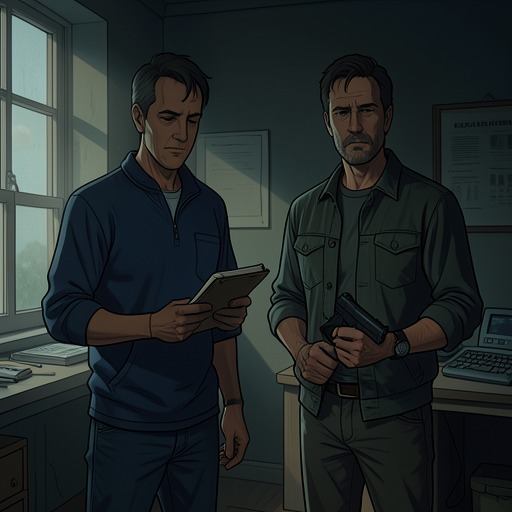
Andy’s second interview with Derek Yoo
Defending JacobAndrew Barber’s second interview with Derek Yoo turns a plea for help into a disclosure that complicates the case against Jacob Barber. Seeking the truth from Jacob’s longtime friend, Andrew learns that Ben Rifkin had bullied Jacob, but also hears Derek describe a private and disturbing side of Jacob: cruelty toward other people, violent stories he read online, and a lost dog that Jacob said he had buried. Derek’s account does not establish what happened to the dog or resolve the murder; it does make clear that Andrew’s picture of his son is incomplete, and that the friendship he hoped to enlist has already changed.
The visit to Derek’s home
Andrew goes to the Yoos’ home in the late morning, knowing Derek is likely to be alone because his parents are at work. Derek and Jacob are still in regular contact by text and sometimes speak on the phone, but only when Derek’s parents are away. Andrew expects Derek to want to help his friend, yet fears that he may refuse to let Andrew in. He arrives prepared to talk his way inside, or even force his way in, and chooses not to knock: he goes around the back of the house rather than give Derek the chance to avoid him.
The visit belongs to a period when Andrew is trying to get his family through Jacob’s trial by suppressing painful conversations and postponing repair until an imagined time he calls After. He has stopped attending to Laurie’s distress and recognizes, in retrospect, that his determination to save Jacob first left his wife alone with her own damage. At Derek’s house, that same urgent focus narrows Andrew’s attention toward the information he believes might help Jacob. His account also registers the strain in his own changed appearance: his clothes sit awkwardly on the weight he has gained, and he feels no impulse to address it because, once again, he assumes there will be time later.
Andrew’s appeal and Derek’s first disclosure
Inside, Andrew cautiously follows Derek from the kitchen into the TV room. He asks for the truth and appeals to their shared friendship, telling Derek that Jacob needs his help. Andrew’s language is both a request and an effort to define what friendship should require. Derek initially answers that Andrew is not supposed to be there, a sign that his parents’ wishes and the awkwardness of the encounter are already barriers. Andrew persists, asking him to tell what has been happening rather than merely accept silence.
Derek explains that Ben Rifkin had been the leader of a group of students who gave Jacob a hard time. This confirms that Jacob had a reason to fear Ben, but Derek immediately resists making that fact the whole explanation. He says Jacob has a mean streak of his own and suggests Ben may not have understood whom he was provoking. When Andrew asks whether this is why Derek posted about the knife on Facebook, Derek says the post had more behind it: Jacob had obtained the knife because he feared Ben might come after him and believed he would need to defend himself. Andrew says he had not known about that fear. The disclosure gives the knife a reported defensive rationale without resolving either the murder or Jacob’s responsibility for his other conduct.
A character Andrew did not know
Derek struggles to describe Jacob’s cruelty as something other than anger. He says Jacob was not prone to getting mad, but could be mean to people who were not his friends. Derek recalls racist jokes and inappropriate remarks about girls’ bodies, and says Jacob read violent sexualized stories online that he called cutter. Derek had seen examples on Jacob’s iPod and found them disturbing. In this account, the troubling material is not offered as proof of a crime; it is part of Derek’s explanation for why he sometimes felt uneasy around Jacob and doubted the image of him as simply a boy pushed into defending himself.
Derek supplies a concrete memory of Jacob laughing loudly at a passerby who used crutches and had difficulty controlling his legs. While the others questioned Jacob’s reaction, Jacob called the man a freak show. Derek remembers the episode as more than an ill-judged joke: it left him uncomfortable and, at times, a little afraid of his friend. His recollection shifts the interview from what Ben did to Jacob toward what Derek believes Jacob was capable of doing socially to people who were vulnerable or outside his circle.
Derek then recalls finding Jacob with a small dog the previous fall. The dog wore a collar and appeared to be lost; Jacob had it on a string rather than a leash. When Derek later asked about it, Jacob said he had had to bury it, without explaining whether the animal had died or what had happened. Derek remembers missing the explanation, seeing notices posted around the neighborhood by the dog’s family, and saying nothing as the posters eventually disappeared. The account remains unresolved: Derek does not claim to have witnessed the dog’s death, and Jacob’s statement is the only explanation he recalls. Its force in the interview comes from the gap between what Derek suspected and what he chose not to ask or report.
The friendship’s altered terms
Andrew’s question about how Derek could remain friends with Jacob after learning these things makes visible the distance that has already opened between them. Derek says they are no longer friends as they were in childhood; they are old friends, but the closeness has diminished. He is unsure whether Jacob ever truly cared about him, explaining that Jacob did not necessarily dislike him but often seemed indifferent. This uncertainty is not a simple declaration that their friendship was false. It is Derek’s attempt to name a bond that has lasted in some form while losing its former intimacy and trust.
Derek’s final observation is that he had always expected Jacob to get into trouble someday, though he assumed it would happen when they were adults. The remark is not a prediction that specifically identifies the murder; it shows how Derek retrospectively places the current crisis against a long-held sense that Jacob might eventually cross a line. The interview ends with the two sitting in silence, aware that what has been said cannot be unsaid. Andrew drives slowly through the town center afterward, prolonging the ordinary ride because he feels that something has ended. The conversation has not given him a definitive account of Jacob’s guilt, but it has broken the comfort of believing that he already knew his son.